I was listening to a discussion on the train last week, involving someone talking to his friends about some kind of alternatives to evolution event he'd been to. The people talking obviously had some feel, some care, for truth; and they were clearly inclining towards a view that while Creationism wasn't very convincing,
Intelligent Design was at least interesting and maybe it should be given more equal status with Darwinian evolution.
While I kept my mouth shut all the way until they got off at Wimbledon (I am English, after all), I would really like to talk to people like them - reasonable people of faith, who might be considering the pros and cons of Intelligent Design, and offer them a line of argument which may in some ways make more sense to them than to the average evolutionist.
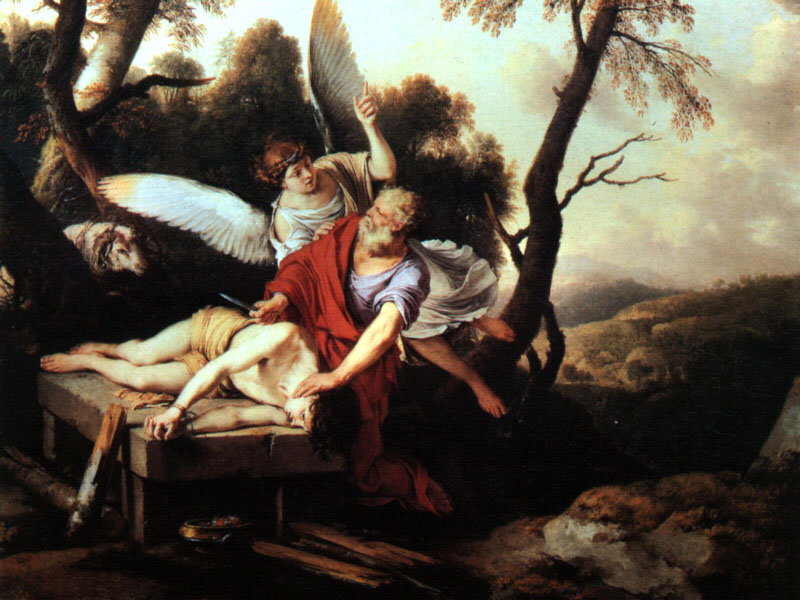
Some years back I was reading a Danish writer who was talking about God's test of Abraham, when he asks him to sacrifice his first-born son Isaac. Now, even as an occasionally resentful second son, I've never liked this episode - in fact I suspect it contributed to my departure from religion. But some - probably misunderstood - memory of his interpretation of the story as a challenge to choice or commitment stuck in my mind, to resurface from time to time.
Another idea that had stuck in my mind was a quotation that had also taken up long term residence there:
"If it could be proved that any part of the structure of any one species had been formed for the exclusive good of another species, it would annihilate my theory, for such could not have been produced through natural selection."
(Charles Darwin - The Origin of Species, 1859, Chapter 6 - Difficulties On Theory, page 201)
Think about how western culture saw nature up to the moment when Origin was published. The general approach was to seek - and find - examples of Divine Providence in the ingeniously helpful disposition of nature. As Darwin continues in the next sentence, "Although many statements may be found in works on natural history to this effect, I cannot find even one which seems to me of any weight."
A few pages earlier, he does something similar:
"If it could be demonstrated that any complex organ existed, which could not possibly have been formed by numerous, successive, slight modifications, my theory would absolutely break down"
(ibid, page 189)
This is just as challenging - an entire strand of Natural Theology had been built on the basis that this was simply not true, including
William Paley's well known
Watchmaker Analogy.
So Darwin is going out of his way to give opponents a chance to "annihilate" or "absolutely break down" his theory - if they cannot, the world must be very different from what they think. And this is not any old "theory", this is his life's work (it is 28 years since his voyage on the Beagle started him on this road) which, he must have realised, could more or less immortalise his family name. This theory is, almost literally, his baby.
Eventually I made a illuminating connection between these two ideas. Darwin's invitation to his readers to "annihilate" his theory takes similar courage to that of Abraham offering to sacrifice his son - each is offering the destruction of their life's greatest achievement, and of their nearest hope to immortality in this world. And each is driven by a greater love - Abraham's, of God, and Darwin's, of truth.
Now, let's look at Intelligent Design. Whereas Darwin said, in effect, that the natural world we live in is totally different from how we thought it was, proponents of Intelligent Design say that it is almost identical but somewhere, somehow, there is something that will demonstrate
Irreducible Complexity or
Specified Complexity - but it appears that they do not even
seek proposals for actual research.
Frankly, this reminds me an ancient TV sketch where Rowan Atkinson parodies a famous science fiction theme by explaining, over a cup of tea, that he comes from a parallel Earth on precisely the other side of the sun, where everything is just like this earth - except that the gearknob of
their Mini Metro has little dimples in it.
Prove me wrong - show me one sentence anywhere in Intelligent Design which shows such courageous love of truth as Darwin's clear and self-imposed tests, and I will revise my views.
But until then, I firmly believe that ID has as much relationship to a brave and beautiful scientific theory as Caligula's horse
Incitatus had to democratically elected leadership.