Showing posts with label Philosophy. Show all posts

Saturday, March 13, 2010

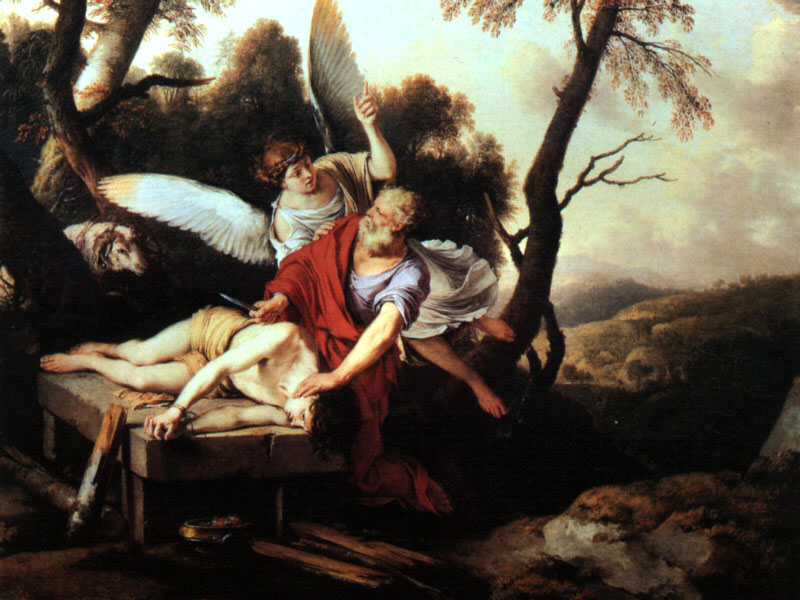
Deeply shallow - why Intelligent Design fails the test of Abraham (and Evolution passes)

I was listening to a discussion on the train last week, involving someone talking to his friends about some kind of alternatives to evolution event he'd been to. The people talking obviously had some feel, some care, for truth; and they were clearly inclining towards a view that while Creationism wasn't very convincing, Intelligent Design was at least interesting and maybe it should be given more equal status with Darwinian evolution.


While I kept my mouth shut all the way until they got off at Wimbledon (I am English, after all), I would really like to talk to people like them - reasonable people of faith, who might be considering the pros and cons of Intelligent Design, and offer them a line of argument which may in some ways make more sense to them than to the average evolutionist.

Some years back I was reading a Danish writer who was talking about God's test of Abraham, when he asks him to sacrifice his first-born son Isaac. Now, even as an occasionally resentful second son, I've never liked this episode - in fact I suspect it contributed to my departure from religion. But some - probably misunderstood - memory of his interpretation of the story as a challenge to choice or commitment stuck in my mind, to resurface from time to time.

Another idea that had stuck in my mind was a quotation that had also taken up long term residence there:
"If it could be proved that any part of the structure of any one species had been formed for the exclusive good of another species, it would annihilate my theory, for such could not have been produced through natural selection."
(Charles Darwin - The Origin of Species, 1859, Chapter 6 - Difficulties On Theory, page 201)

Think about how western culture saw nature up to the moment when Origin was published. The general approach was to seek - and find - examples of Divine Providence in the ingeniously helpful disposition of nature. As Darwin continues in the next sentence, "Although many statements may be found in works on natural history to this effect, I cannot find even one which seems to me of any weight."

A few pages earlier, he does something similar:
"If it could be demonstrated that any complex organ existed, which could not possibly have been formed by numerous, successive, slight modifications, my theory would absolutely break down"
(ibid, page 189)

This is just as challenging - an entire strand of Natural Theology had been built on the basis that this was simply not true, including William Paley's well known Watchmaker Analogy.

So Darwin is going out of his way to give opponents a chance to "annihilate" or "absolutely break down" his theory - if they cannot, the world must be very different from what they think. And this is not any old "theory", this is his life's work (it is 28 years since his voyage on the Beagle started him on this road) which, he must have realised, could more or less immortalise his family name. This theory is, almost literally, his baby.

Eventually I made a illuminating connection between these two ideas. Darwin's invitation to his readers to "annihilate" his theory takes similar courage to that of Abraham offering to sacrifice his son - each is offering the destruction of their life's greatest achievement, and of their nearest hope to immortality in this world. And each is driven by a greater love - Abraham's, of God, and Darwin's, of truth.

Now, let's look at Intelligent Design. Whereas Darwin said, in effect, that the natural world we live in is totally different from how we thought it was, proponents of Intelligent Design say that it is almost identical but somewhere, somehow, there is something that will demonstrate Irreducible Complexity or Specified Complexity - but it appears that they do not even seek proposals for actual research.

Frankly, this reminds me an ancient TV sketch where Rowan Atkinson parodies a famous science fiction theme by explaining, over a cup of tea, that he comes from a parallel Earth on precisely the other side of the sun, where everything is just like this earth - except that the gearknob of their Mini Metro has little dimples in it.

Prove me wrong - show me one sentence anywhere in Intelligent Design which shows such courageous love of truth as Darwin's clear and self-imposed tests, and I will revise my views.

But until then, I firmly believe that ID has as much relationship to a brave and beautiful scientific theory as Caligula's horse Incitatus had to democratically elected leadership.

Friday, February 26, 2010

Learning, understanding and storytelling

An interesting post in Zen Habits on how to ace exams without studying explains and illustrates the difference between learning by rote and learning by "making connections".

While Scott Young includes "storytelling to remember facts and numbers" as one of five connection-making techniques for non-rote learning, I'm interested in a deeper connection, partly in the hope of understanding my own strengths and weaknesses in this area. Metaphor (his first technique) has, after all, some kind of implicit narrative. There has to be some kind of context in which the "stage" and its "players" and their "entrances" and "exits" mean something, before I can add that meaning to my understanding of "men" and "women". The same is more or less obviously true of his other techniques, like "Explain it to a five year old" (how would you do that without telling stories?) - read it, you'll see.

So the way to learn something is to make sense of it, to connect it to the things in our life which already have meaning for us. That's what stories and metaphors do.

This raises an interesting question - can I do this for my life as a whole? Is there some connection between, say, my interest in Metaphors We Live By, and my activities in Impro, does it all fit together?

I don't know yet, but I'll keep wondering.

And wandering.

Wednesday, January 16, 2008

Opting out off organ donation - a helpful proposal?

So our Prime Minister thinks it should be assumed that we are all willing to donate our organs to medicine unless we explicitly opt-out or our families object.

Though I'm not a great fan of yet another state intrusion into a pretty damn personal realm, on consideration I think I'm coming round to this idea.

After all, symmetry and reciprocity are always good ingredients for any ethical recipe. And it seems to me that there is an implicit assumption that we would be willing organ recipients, though of course some have principled objections to that, too.

So perhaps it would be helpful, in more ways than one, to include on the opt-out form this second question:
Would you be willing to accept a donated organ if it was determined that you needed one but, due to unconsciousness or other problems, you were not in a position to give your consent?
Personally, I'm willing to donate. It's right there, in writing. So I feel free to accept. And to indulge myself with perhaps odiously smug comments on the matter.

Sunday, October 14, 2007

The other view

Well, after the somewhat negative tone of an earlier post commenting on a TechCrunch item, here's something to get your eyes on the horizon, your foot on the accelerator and your heart in gear.

To hear the following Teddy Roosevelt quote from someone with the entrepreneurial credentials of Yossi Vardi really adds something special:

It is not the critic who counts; not the man who points out how the strong man stumbles, or where the doer of deeds could have done them better. The credit belongs to the man who is actually in the arena, whose face is marred by dust and sweat and blood; who strives valiantly; who errs, who comes short again and again, because there is no effort without error and shortcoming; but who does actually strive to do the deeds; who knows great enthusiasms, the great devotions; who spends himself in a worthy cause; who at the best knows in the end the triumph of high achievement, and who at the worst, if he fails, at least fails while daring greatly, so that his place shall never be with those cold and timid souls who neither know victory nor defeat.

Churchillian, I'd call that, except that Churchill was always better on matters of war than more subtle and pervasive issues like citizenship.

Wednesday, February 21, 2007

Of Barbies and burqas

Interesting comment by Ophelia Benson on what religious fundamentalism and the commercial sexualisation of ever-younger girls have in common. Have I become a feminist without realising it?

Of course, the complexity always seems to re-emerge under a different bit of the carpet. Even at eighteen months we see our firstborn as "all boy". Naturally we both hope for him to grow into a happy and fulfilled man, so maybe we take even more pleasure in those sides of his character which we hope will help him become an alpha male (such as the fearlessness and joy with which he clambers up his cot and somersaults over the edge onto the sofa) than we would if he was a girl.

And marriage itself teaches you a lot (especially those innocents who've never lived with a partner before) about the reality of the differences of the sexes. But then it teaches you a whole lot about the realities of individual difference, and about adjusting to them.

As with religion, I think I respect sexual difference because it's an indivisible property of individuals - it's when you turn that around that things seem to start going wrong.

Thursday, February 08, 2007

The semantic web - no longer a pipe-dream?

Let me be rash - I've just had my first look at Yahoo pipes and I think this will prove a major milestone in the evolution of the web. I believe that the semantic web is appearing under our noses, not as the result of the ontologies and predicate reasoning that I used to imagine would be involved, but through a rapid evolution of bottom-up folksonomies and strength-off-association relationships, which in fact are a better fit to the loose-fit metaphorical reasoning we actually use in practice.

I'm too tired and coffee-wired and busy right now to write my own pipe - but I'll be doing it as soon as work and domestic circumstances permit.